From Data to Decisions: 4 Takeaways from Our Midwest Regional Webinar
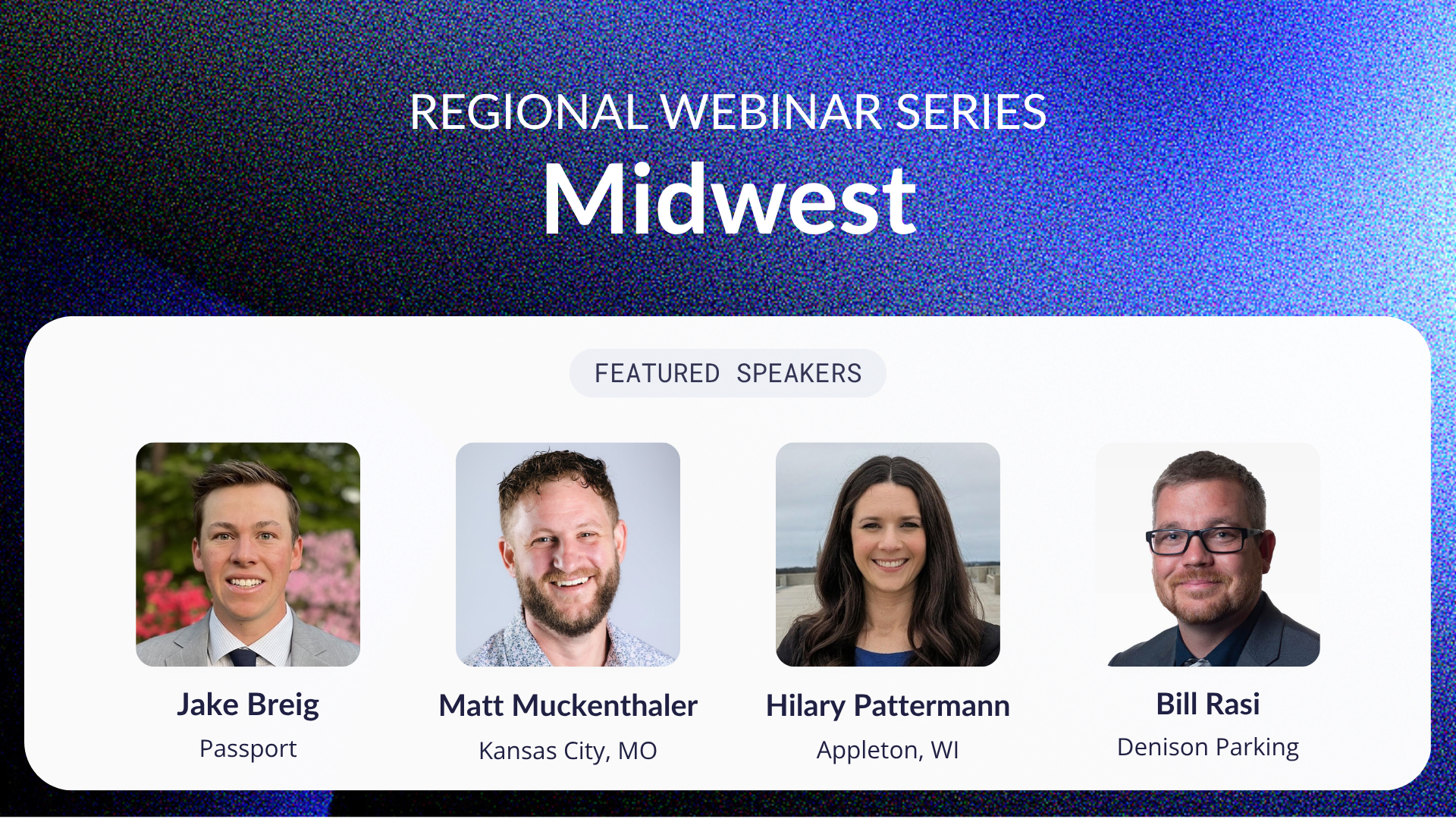
In partnership with MPMA (Midwest Parking & Mobility Association), Passport recently hosted the second installment of our Regional Webinar Series. Moderated by Jake Breig, Regional Sales Director at Passport, the conversation brought together three perspectives on how data shows up in day-to-day parking operations:
- Matt Muckenthaler, Parking Division Manager, Kansas City, MO
- Hilary Pattermann, Parking Manager, City of Appleton, WI
- Bill Rasi, Regional Director, Denison Parking
Together, the panel represented a mid-size regional hub, a large metro, and a private operator running facilities in 13 cities. Asked to describe their relationship with data in one word, they chose new, layered, and actionable.
Missed it live? Watch the full webinar recording here.
1. Where the data comes from depends on who you are
In Kansas City, data is layered. Matt described inputs from on-street meters, garage equipment, four LPR-equipped vehicles collecting occupancy scans, a multi-app mobile payment environment, enforcement software, and even occupancy lighting in some garages. All of it flows into a BI tool that he checks almost daily.
Appleton is earlier in the journey. Hilary noted that the data has always existed, but under previous leadership it wasn’t being used. Today, her team pulls from ramps, mobile payments, citations, and customer service feedback, often compiling it by hand into a spreadsheet.
For Denison, the challenge is breadth. As a tech-agnostic operator, Bill’s team pulls from hundreds of sources. He added that the size of Denison’s footprint in a market determines how useful its data is there.
One point surfaced for everyone: aggregating parking data rarely works out of the box.
2. Data that changed a decision, not just informed it
The heart of the conversation focused on real examples of data driving action.
Appleton: Visible enforcement changes behavior. This summer, Appleton began tracking enforcement hours against paid mobile sessions and meter citations. The trend was clear: more visible enforcement led to more paid sessions and fewer citations. The validation came the day before the webinar. When a four-hour conference came to town, attendees skipped the two-hour on-street spaces and filled both downtown ramps instead, leaving curb space open for quick trips to local shops and coffee spots. “We don’t want to discipline them by issuing them a meter citation,” Hilary said. The goal is compliance.
Denison: Revenue management becomes inventory management. Data showed that customers were booking parking as far as 30 days in advance, and not just for events. Denison responded by listing inventory earlier and managing price points as dates approach. The philosophy is simple: fill the spaces first. “We’re not going to make money unless the cars are parking with us,” Bill said.
Kansas City: Removing paid parking. Matt offered the most surprising example. As downtown shifts toward remote work, some blocks in north downtown generate only a few cars a day. Enforcing them costs more than they bring in. So Kansas City is removing paid parking from those blocks and redeploying resources where they matter.
3. The hardest part isn’t always the data. It’s the story.
Every panelist named a different obstacle. For Hilary, it’s capacity: office staff is often just her. For Bill, it’s fragmentation across dozens of platforms, plus contracts that don’t provide data access at all. For Matt, it was accuracy. Early on, Kansas City couldn’t even quantify its on-street ADA spaces without physically counting signs, and LPR required significant tuning to read the curb accurately.
Once the data is in place, the next challenge is explaining it. Internal buy-in was strong across the panel, but external audiences are harder to reach. Matt noted that very few members of the public are “parking nerds,” so part of the job is explaining why a metric matters to business owners, residents, and commuters. Bill added that whoever presents the data has to be able to tell the story behind it.
Hilary shared what can happen when that story goes untold. About three years ago, because Appleton wasn’t reporting its parking data, council began exploring privatizing the city’s ramps. Proactive reporting and education have since turned that perception around.
4. Looking ahead, and where to start
The panel’s goals for the next year reflect where each is in their journey. Appleton hopes to add a dedicated data analyst. Denison aims to finish its integrations and deliver polished, consistent reporting to clients. Kansas City wants to move from data “in arrears” to predictive insights, such as forecasting year-end results or anticipating how weather affects demand.
For cities just getting started, the panel offered practical advice:
- Track mobile pay adoption as a trend line, not a snapshot. Matt also noted that mobile pay signage is a low-cost way to pilot paid parking in a new area.
- Measure average daily revenue per space. It makes curb performance easier for stakeholders to understand than an annual block total.
- Pair enforcement data with payment data. Bill recommended comparing scans against paid sessions to understand duration of stay, which can inform rate bands and officer routes.
The big picture
Jake closed with a theme that ran through the whole conversation: every city and operator is at a different stage in its data journey, and that’s okay. In the Midwest especially, progress comes from steady measurement, not moonshots. Small, data-backed improvements add up to significant change over time.
Hear the full discussion, including attendee Q&A and Hilary’s famous “Guess That Mess” segment, in the complete recording.
