Manage Compliance Like Never Before
Seamless Integrations to Verify Violations
Enforcing compliance in your operation has never been easier, faster or more accurate.
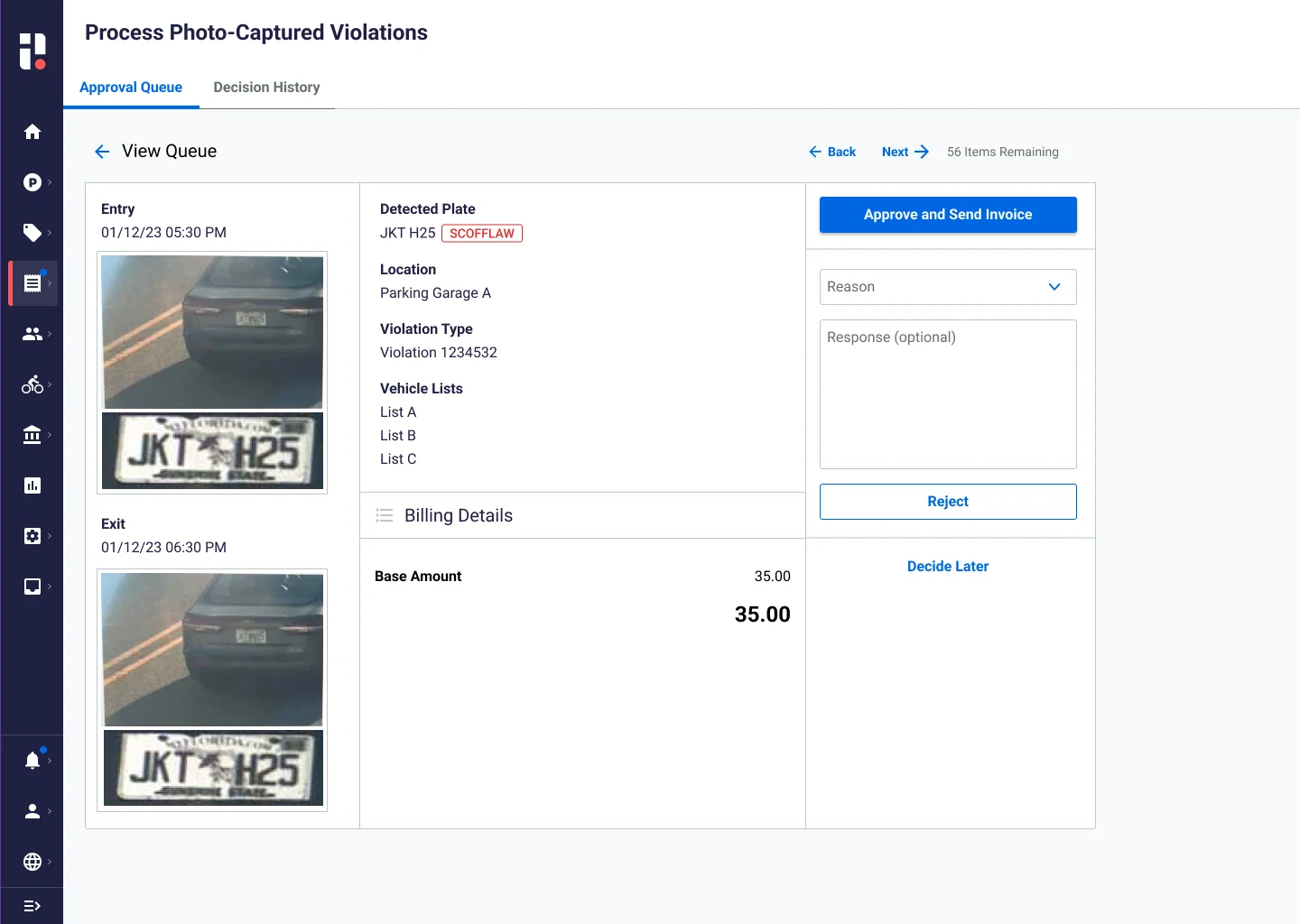
Passport’s Photo Enforcement solution enables municipalities and private operators to manage on and off-street parking with camera-based technology by capturing violations in real-time and automating issuance of citations by direct mail or directed enforcement.

Core Benefits
- Enforce more accurately with real-time transfer of data
- Receive updates on time limits, permit or scofflaw violations between the LPR camera, back office, and violator payment portal
- Access custom reporting and LPR queue for permissible use scenarios to make more strategic decisions for your operations
- Improve the violator experience by providing a transparent and seamless life cycle of the violation from start to finish



Frequently Asked Questions
Photo enforcement parking software uses fixed or mobile cameras to automatically capture images of parking violations. Each photo is timestamped, GPS-stamped, and paired with license plate data to create a complete evidentiary record. Officers or automated systems review the captures and issue citations — no officer presence at the moment of violation is required.
Fixed cameras scan vehicles in a parking area continuously or at set intervals. When a violation is detected — such as an expired meter or permit violation — the system captures a photo, reads the license plate, verifies permit status, and queues the record for citation issuance. The full process takes seconds and creates a defensible evidentiary record.
Digital chalking replaces traditional tire-chalk marking with a mobile device or camera system that photographs a tire's valve stem position and records a GPS-stamped timestamp. When an officer returns, the system compares the new image to the original — if the vehicle hasn't moved beyond the time limit, a citation is issued automatically. No physical chalk is needed.
Digital chalking tracks time-limited parking violations by comparing tire images over time — used in zones where duration of stay matters regardless of payment. LPR enforcement reads license plates to verify permit status or payment in real time. Both are components of a modern parking enforcement platform; many cities use both depending on zone type.
contact passport sales
Ready to Get Started?
Get in touch and a product specialist will get back to you shortly.

Talk to a Specialist